
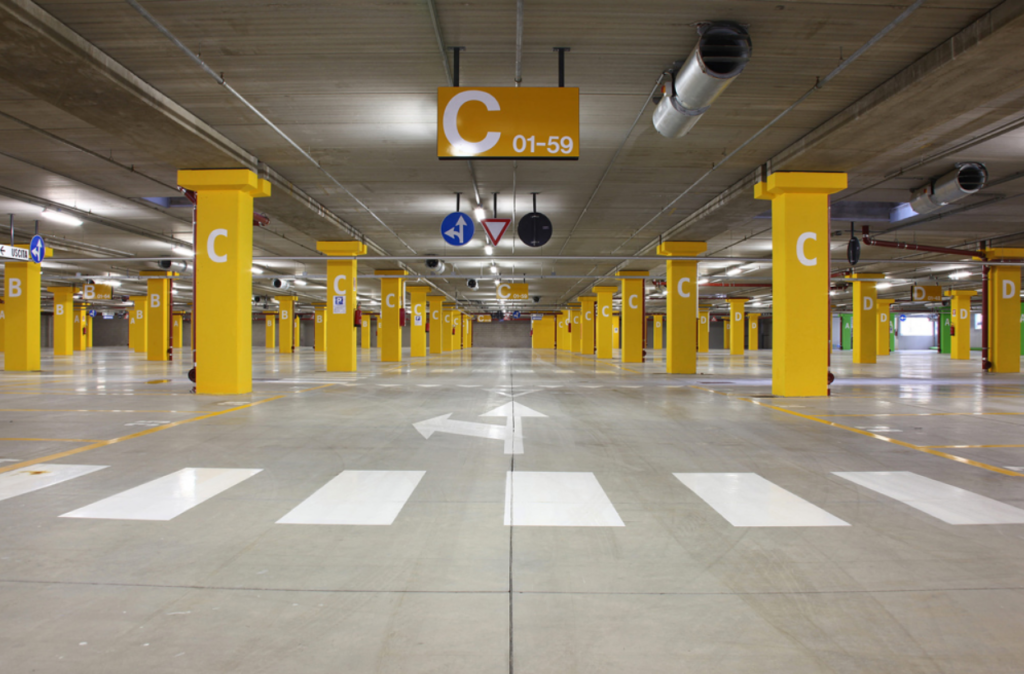
If you’ve ever walked through an underground parking garage and felt the air go stale halfway in, you’ve seen the problem ducted systems were built to solve. But for projects over 2,000 m², a growing number of engineers are choosing jet fans instead — and the reasons are practical, not theoretical.
What a Jet Fan Actually Does
Mounted on the ceiling, these compact axial or radial fans throw a high-velocity air jet that pushes large volumes of air across the garage toward exhaust shafts. No ductwork needed.
On a normal day, CO sensors placed throughout the space tell the fans when to speed up or slow down, keeping carbon monoxide below safe limits and preventing dead zones where air simply doesn’t move. In a fire, only the fans in the affected fire zone kick in, channeling smoke toward extraction points so evacuation routes stay visible and firefighters can work.
Every fan should carry **EN 12101-3 certification (F300/F400)**, with IP55 housing and H-class motors built to handle hot smoke. Two-speed motors and inverter control add real energy savings over time.
Where It Beats Ducted Ventilation
The biggest difference is ceiling height. Without ducts running everywhere, you keep the full clearance the architect intended — and you don’t lose parking spaces to mechanical rooms. Installation is faster, commissioning is simpler, and energy consumption can drop by up to 40% simply because there’s no duct pressure loss to overcome. That smaller load also means you can size the emergency generator down.
Maintenance is easier too. Ceiling-hung fans are straightforward to access; there’s no heavy duct cleaning schedule to plan around.
On the safety side, you have two design paths: a 10 air-change smoke-reduction mode for standard car parks, or a heat-and-smoke control mode for higher-security projects. For anything demanding, CFD simulation is worth the effort — it catches airflow problems before construction does.
A Few Things Designers Often Miss
Fire zones need to be properly divided, each with its own exhaust shaft. Plan for at least two backup exhaust fans per shaft, fitted with motorized back-draft dampers to stop air from short-circuiting. And always check clearance from sprinklers and ceiling obstructions — a jet fan blocked by a beam is just an expensive paperweight.
When integrated with a CO monitoring panel and the building’s fire alarm system, jet fans handle both everyday ventilation and emergency smoke extraction in one package. That’s why they’ve become the default choice for modern enclosed and underground car parks in so many markets.Working on a car park ventilation project?** Send us your layout and we’ll recommend the right axial or radial jet fan configuration — with EN 12101-3 certified units and full technical support.
 English
 Chinese
 Russian