
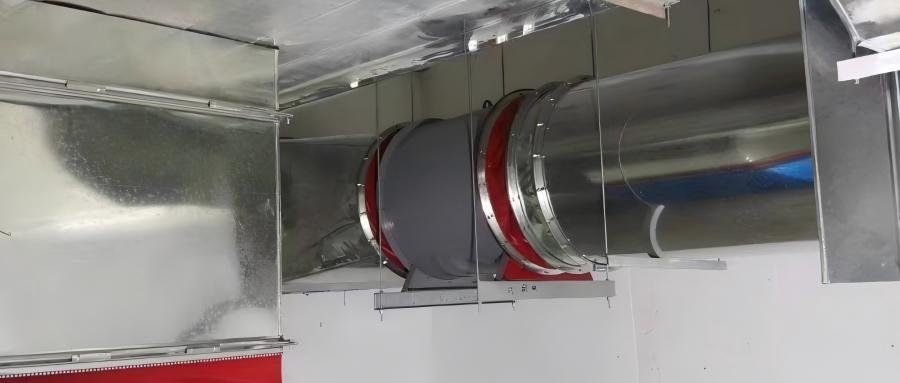
Fire safety is a critical consideration in modern building design, and among the most vital components of any fire protection system is the **fire smoke exhaust fan**. These specialized fans play an essential role in protecting lives and property by removing smoke and toxic gases during a fire emergency, enabling safe evacuation and supporting firefighting operations.
This article provides a comprehensive overview of how fire smoke exhaust fans work, their key components, and the integrated monitoring systems that ensure their reliable operation.
What Is a Fire Smoke Exhaust Fan?
A fire smoke exhaust fan is a mechanical ventilation device specifically designed to extract smoke, heat, and combustion products from a building during a fire. Unlike standard ventilation fans, these units must withstand extreme temperatures — typically up to 300°C for 120 minutes (F300 rating) or even 400°C for 120 minutes (F400 rating).
The fundamental operating principle is straightforward: the motor drives an impeller (fan blades) to rotate at high speed, creating negative pressure that draws smoke-laden air through the intake and discharges it safely outdoors. This process removes smoke from the fire zone, improves visibility for evacuation, reduces thermal load on the building structure, and creates a stable smoke-free layer in the lower area where rescue operations can be conducted.
Dual-Speed Dual-Power Fire Smoke Exhaust Fans
One of the most advanced configurations in the industry is the “dual speed dual power” fire exhaust fan, which provides excellent flexibility and reliability
The Four Main Components
A typical dual-speed dual-power fire smoke exhaust fan consists of four parts:
1. **Dual-speed electric motor** — Enables operation at two distinct speeds
2. **Air-cooled diesel engine** — Provides backup power during electrical failure
3. **Intelligent control system** — Manages automatic operation and fault diagnosis
4. **Ventilator/fan assembly** — The impeller and housing that move air and smoke
Dual-Speed Operation
The dual-speed design allows the fan to serve two distinct functions:
– “Low-speed mode” — Used for normal daily ventilation, circulating fresh air throughout the building
– “High-speed mode” — Automatically activated during a fire emergency for maximum smoke extraction
This “one machine, two uses” approach eliminates the need for separate ventilation and smoke exhaust systems, significantly reducing equipment costs and space requirements.
Dual-Power Drive
The dual-power configuration ensures uninterrupted operation even during power outages:
– “Primary power” — The electric motor runs on standard utility power under normal conditions
– “Backup power”— When utility power fails, the system intelligently switches to the diesel engine within seconds, ensuring continuous fan operation
This automatic failover capability is critical because fire emergencies often coincide with power disruptions.
Integrated Monitoring and Control System
Modern fire smoke exhaust fans are typically part of an “integrated monitoring and control system” that centralizes data collection, processing, control, communication, and display functions.
System Components
The integrated monitoring system comprises four key elements:
1. Sensors and Actuators
Temperature sensors and smoke detectors are strategically distributed throughout the building’s critical zones to continuously monitor environmental conditions. When a fire or abnormality is detected, these sensors immediately transmit signals to the controller.
The system also includes actuators that control the fans — automatically opening or closing them based on commands from the controller to enable smoke exhaust or air supply functions.
2. Controller — The “Brain” of the System
The controller receives data from all sensors, analyzes it using preset logic algorithms, and issues appropriate control commands to the actuators. Beyond basic control, modern controllers feature:
Automatic fault diagnosis — Continuously monitors system health and identifies issues
Automatic online inspection — Performs regular self-tests without manual intervention
Automatic program control — Executes pre-programmed fire response scenarios
Automatic process control — Manages operational sequences automatically
Automatic data acquisition — Collects and stores operational data for analysis
3. Communication Network
Using either wired or wireless infrastructure, the communication network enables data exchange and command transmission between the controller, host computers, and other fire protection equipment. Modern systems increasingly leverage IoT (Internet of Things) technologies such as NB-IoT for real-time remote monitoring.
4. Host Computer Software
Installed in the fire control room or remote monitoring center, the host software provides a user-friendly human-machine interface. Operators can:
– Visually monitor the entire system’s operational status
– Execute remote control commands
– Adjust system parameters
– Access historical operation records
This capability is often referred to as the “Four Remotes” : remote adjustment, remote signaling, remote monitoring, and remote control.
System Functions and Benefits
A fully integrated monitoring system delivers several critical advantages:
| Function | Description |
| 24/7 Real-Time Monitoring | Continuous surveillance of environmental parameters with immediate alerts via audible alarms, SMS, and other notifications |
| Automatic/Manual Control | Automatic operation based on preset fire scenarios, with manual override capability for special situations |
| Data Recording & Analysis | Storage of fire records, fan operation status, maintenance logs, and other historical data for troubleshooting and performance evaluation |
| Linked Control | Coordination with fire alarm systems, sprinkler systems, and other fire protection equipment to form a comprehensive fire defense network |
Intelligent Control Advantages
The intelligent control system requires no specialized programming expertise — all functions are pre-configured and automated. Additionally, the system includes communication interfaces that enable direct connection to central control centers for comprehensive monitoring and record-keeping.
Applications
Dual-speed dual-power fire smoke exhaust fans and their associated monitoring systems are widely deployed in critical environments including:
– Industrial and mining facilities
– Tunnels and underground passages
– Subway systems
– Underground parking garages
– Commercial buildings and high-rise structures
– Elevator lobbies and stairwells
– Oil and gas field operations
– Military installations
Conclusion
Fire smoke exhaust fans are indispensable components of modern building fire protection systems. The evolution from simple single-speed fans to sophisticated dual-speed dual-power units with integrated monitoring and control represents a significant advancement in fire safety technology.
By combining “dual-speed operation” for dual-purpose use (daily ventilation + emergency smoke extraction), “dual-power drive” for uninterrupted operation during power failures, and “intelligent monitoring systems” for real-time supervision and automated control, these systems provide comprehensive protection that saves lives and minimizes property damage.
When selecting a fire smoke exhaust system, it is essential to consider factors such as temperature rating (F300, F400, etc.), airflow capacity, power configuration, and monitoring capabilities to ensure compliance with local building codes and standards.
For more information about fire smoke exhaust fans and integrated monitoring solutions, please contact our team or explore our product catalog.
 English
 Chinese
 Russian