
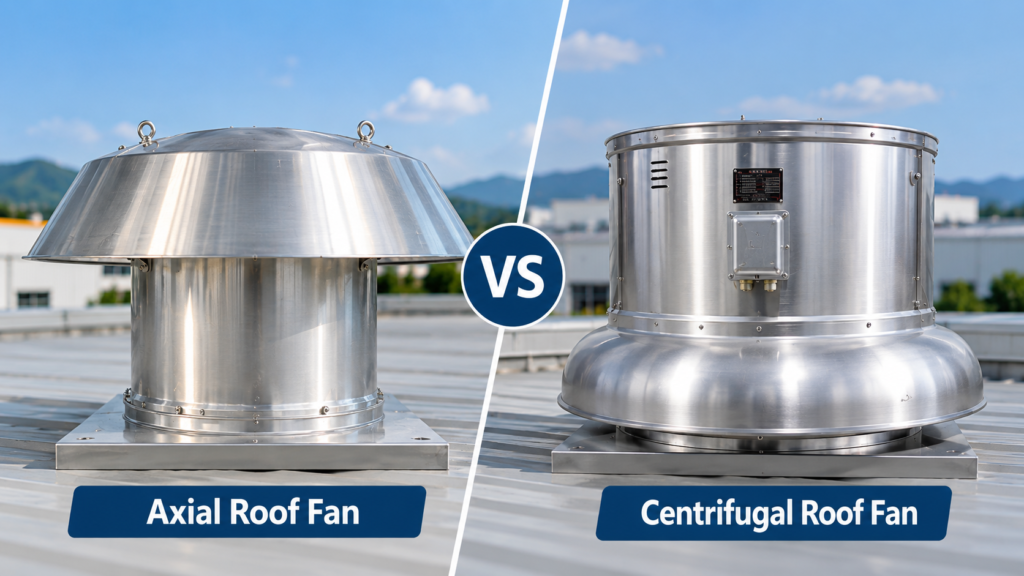
Roof fans are widely used in factories, warehouses, workshops and commercial buildings to remove hot air, fumes and stale indoor air.
Two common options are axial roof fans and centrifugal roof fans. They may look similar from outside, but their working conditions are quite different.
Axial Roof Fan
An axial roof fan moves air directly through the impeller in an axial direction.
Its main advantage is large airflow with relatively low pressure.
It is commonly used for:
- Factory ventilation
- Warehouse exhaust
- Workshop heat removal
- General building ventilation
- Areas with short or simple air paths
For applications where a large amount of air needs to be exhausted directly through the roof, an axial roof fan is usually a simple and economical solution.
Centrifugal Roof Fan
A centrifugal roof fan changes the direction of the airflow through a centrifugal impeller.
Compared with an axial fan, it can normally provide higher pressure and is better suited to systems with greater airflow resistance.
Typical applications include:
- Buildings connected to ductwork
- Commercial ventilation systems
- Industrial exhaust systems
- Applications with filters, silencers or longer ducts
- Systems requiring higher static pressure
What Is the Main Difference?
The choice should not be based only on fan diameter or motor power.
The most important parameters are:
气流 How much air needs to be exhausted, normally expressed in m³/h.
Static pressure The resistance created by ducts, bends, filters, louvers and other system components.
Installation condition Direct roof exhaust normally requires less pressure than a duct-connected ventilation system.
As a general rule:
Large airflow + low resistance → Axial roof fan
Higher resistance + duct system → Centrifugal roof fan
Information Needed Before Fan Selection
Before selecting a roof fan, it is useful to provide:
- Required airflow
- Required static pressure
- Building or workshop size
- Roof installation dimensions
- Duct size and length, if applicable
- Voltage and frequency
- Indoor air temperature
- Whether the air contains dust, oil mist or corrosive gas
If airflow and pressure are not available, the operating conditions and building dimensions can also be used as the starting point for fan selection.
Final Selection
There is no single roof fan suitable for every ventilation system.
For simple factory or warehouse exhaust, an axial roof fan is often sufficient. For systems with ducts or higher resistance, a centrifugal roof fan may provide more stable performance.
Selecting the fan according to the actual airflow and system resistance is more important than simply choosing a larger motor or fan diameter.
Nanzhi Machinery supplies axial roof fans, centrifugal roof fans and customized ventilation solutions for industrial and building ventilation projects.
For fan selection, please provide your required airflow, pressure, voltage and application conditions.
 English
 Chinese
 Russian