
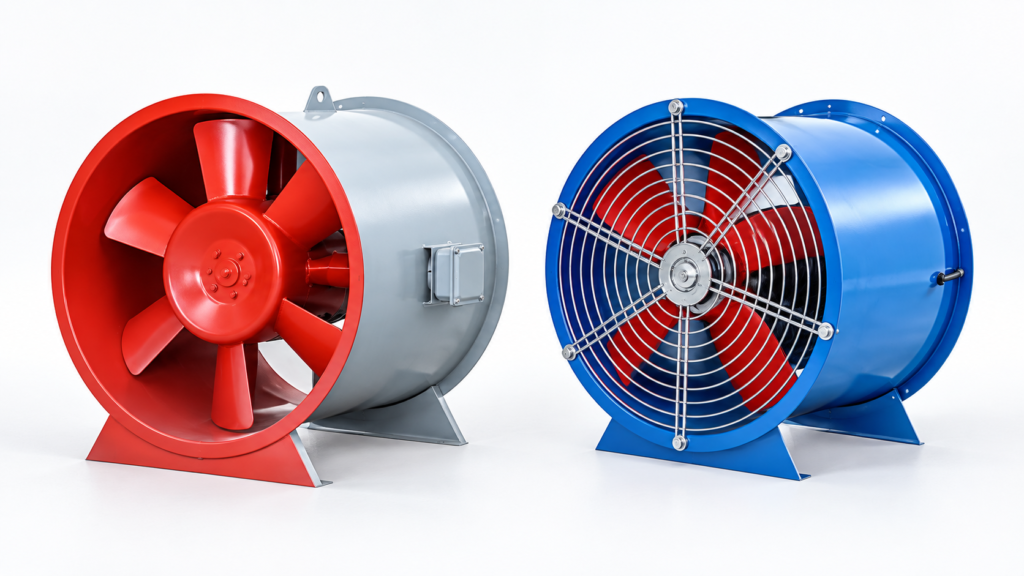
A fire smoke exhaust axial fan can look very similar to a standard axial ventilation fan. Both may use a cylindrical casing, axial impeller and direct-drive motor.
The main difference is not the appearance. It is the operating condition the fan is designed for.
A standard axial fan is mainly used for normal ventilation, while a fire smoke exhaust fan may need to handle both daily ventilation and emergency smoke extraction.
Standard Axial Fan
A standard axial fan is commonly used for general supply and exhaust ventilation in factories, warehouses, equipment rooms and commercial buildings.
Selection normally focuses on airflow, static pressure, motor power, voltage and frequency, noise, and installation size. For normal-temperature ventilation, this type of fan is usually sufficient.
Fire Smoke Exhaust Axial Fan
A fire smoke exhaust fan has an additional requirement: it must continue operating under the specified high-temperature fire condition.
For many building projects, the same fan is also used for normal ventilation. A common solution is a dual-speed motor:
Low speed – daily ventilation
High speed – emergency smoke exhaust
This allows one fan to serve two operating conditions instead of installing separate fans for normal ventilation and fire smoke extraction. Some projects also use a VFD for normal speed control, depending on the project design and fire-control requirements.
High-Temperature Motor
For our fire smoke exhaust axial fans, we normally provide a Class H high-temperature motor according to project requirements.
However, the motor is only one part of the complete fan. A Class H motor alone does not mean that the entire fan automatically meets a specific fire-temperature classification. The casing, impeller, shaft, bearings and complete fan assembly must also be suitable for the required operating condition.
F300 and F400 for European Projects
For European building ventilation projects, requirements such as F300 and F400 are increasingly common.
Project specifications may also state F300-120, F400-120 or EN 12101-3. When requesting a quotation, it is better to provide the exact temperature class, operating duration and certification requirement. Simply asking for a “high-temperature fan” is not enough.
What Information Should Be Provided?
If the fan will be used for both daily ventilation and emergency smoke extraction, we recommend providing both operating points.
Daily ventilation: 18,000 m³/h @ 250 Pa
Emergency smoke exhaust: 30,000 m³/h @ 500 Pa
Also provide voltage and frequency, single-speed or dual-speed requirement, required fire rating, operating duration, installation position and required certification. This allows the fan manufacturer to check whether one fan can meet both duties.
Conclusion
A fire smoke exhaust axial fan is not simply a standard axial fan with a different motor.
It is designed for a different operating duty and may need to combine daily ventilation, high-temperature smoke extraction and dual-speed operation in one unit. For building ventilation projects, the correct fan should be selected according to airflow, pressure, operating mode and fire-performance requirements.
 English
 Chinese
 Russian