
Most RFQs we get for factory roof fans lead with airflow. “We need 10,000 m³/h,” the email says, maybe a roof opening size. Static pressure? Usually blank.
That’s the spec that determines whether the fan actually moves that 10,000 m³/h once it’s installed — or whether it stalls against a duct system it was never sized for.
What Static Pressure Actually Means
Static pressure is the resistance the fan has to overcome to push air through your ventilation system. Ducts, bends, filters, louvers, grilles — every component in the line adds resistance. Add them up and that’s the pressure the fan needs to deliver at your required airflow.
A useful way to think about it: airflow is how much air you want moving. Static pressure is how hard the fan has to work to move it. Get one right without the other and the fan doesn’t perform as advertised.
When It Goes Wrong
Spec the static pressure too low and the fan can’t push through the resistance. Airflow drops well below what you calculated, heat and fumes build up, and you’re left wondering why the “10,000 m³/h” fan you bought is moving half that.
Spec it too high and you’re paying for motor capacity and energy you’ll never use. The fan runs inefficiently, your operating cost climbs, and the oversized motor draws more current than the system actually needs.
Neither one is obvious from the nameplate once the fan is on the roof. You only find out when the ventilation isn’t working — or when the power bill arrives.
How to Get the Number Right
It comes down to your system layout. Duct length and diameter, number of bends, filter type, inlet and outlet louvers, whether you’re exhausting straight through the roof or pushing air through a ducted run — all of it adds up.
If you have a system schematic, an engineer can calculate total resistance directly. If you don’t, a plain description of the layout is usually enough for a working estimate: where the fan sits, how far the air travels, what it passes through before it exits.
Matching the Fan to the System
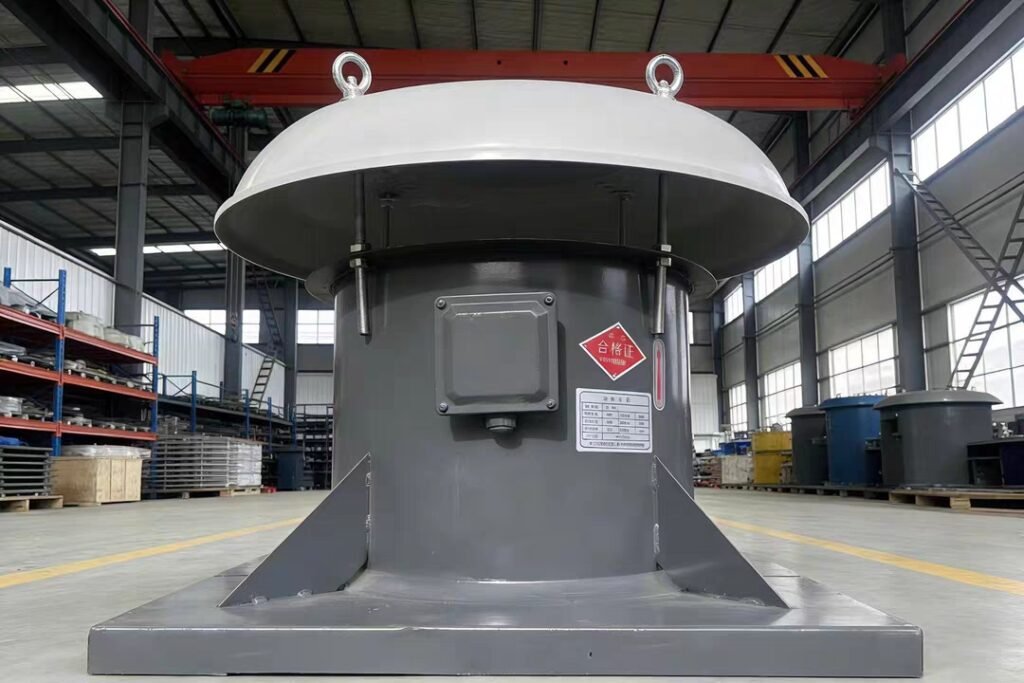
For straightforward roof extraction — hot air, smoke, general fumes exhausting straight up — our [industrial axial roof fan]covers most factory applications. The mushroom housing is designed to improve outflow and keep operating noise down.
When the system has ductwork, filters, or longer runs that add resistance, you need more pressure head. Our [pressurized roof fan]is built for that scenario — it holds airflow against higher system resistance instead of dropping off the curve.
And if you’re replacing an existing roof-mounted exhaust unit, our [roof exhaust fan range]covers the common sizes and configurations for direct extraction.
If You’re Not Sure
Send us what you have — airflow requirement, roof opening size, a sketch or photo of the duct layout if you’ve got one. We’ll work out the static pressure requirement and recommend a fan that matches the actual system, not just the airflow number on paper.
 English
 Chinese
 Russian