
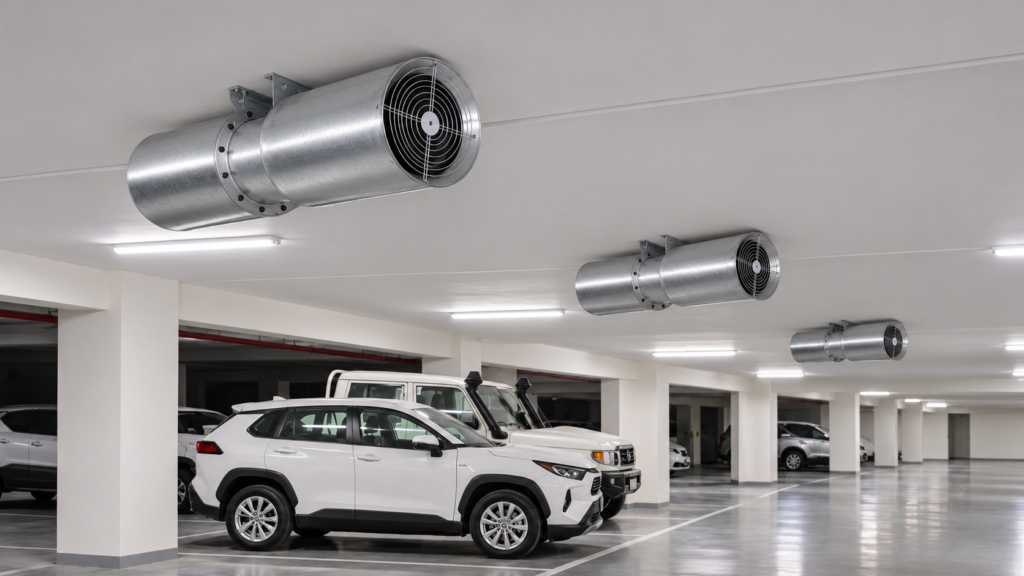
In an underground parking garage, choosing the right fan is only one part of the ventilation system.
The next question is how the fans are controlled during normal operation and what happens when the fire alarm system is activated.
A practical solution is to combine CO detectors, fan control panels and ventilation or smoke exhaust fans into one system.
CO Detection for Daily Ventilation
During normal operation, CO detectors monitor carbon monoxide levels in the parking area.
When the CO concentration reaches the control value defined by the project, a signal is sent to the fan control panel.
The panel can then:
- Start the required fans
- Stop unnecessary fans
- Switch fan speed
- Control fans through a VFD
This allows the ventilation system to operate according to actual demand instead of running all fans at full speed continuously.
The exact CO control value should follow the project design and local requirements.
One Control Panel Can Control Multiple Fans
A single control panel can be designed to manage several fans in the same ventilation zone.
For example, one cabinet may control 10 fans, depending on:
- Motor power
- Starting method
- Number of control circuits
- VFD configuration
- Project electrical design
The system can also divide fans into different groups so that only the required zone operates.
This is especially useful for large underground parking garages with several ventilation or smoke exhaust fans.
Dual-Speed or VFD Control
For dual-speed fans, the control logic is simple:
Low speed — normal ventilation
High speed — higher ventilation demand or emergency smoke exhaust
Another option is VFD control.
During normal operation, the fan speed can change according to actual ventilation demand.
This can reduce unnecessary airflow and energy use when traffic is low.
For fire operation, however, the emergency control mode should be defined separately according to the project fire-control and electrical design.
Fire Alarm Interlock
The fan control panel can also be connected to the customer’s fire alarm or smoke-control system.
Under normal conditions, the fan may operate according to CO concentration.
When a fire signal is received, the control priority changes.
A typical sequence is:
Normal condition:
CO detector → control panel → daily ventilation mode
Fire condition:
Fire alarm system → control panel → emergency smoke exhaust mode
For a dual-speed smoke exhaust fan, this may mean switching directly from low speed to high speed.
For a VFD-controlled system, the emergency operating mode should be confirmed according to the project design.
A Complete Ventilation Control Solution
For parking garage projects, the system does not need to stop at the fan itself.
A complete package can include:
Ventilation or smoke exhaust fans + CO detectors + fan control panels + VFD control + fire alarm interlock
The control cabinet can be customized according to the number of fans, motor power and ventilation zones.
This makes the overall system easier to coordinate during design, installation and commissioning.
 English
 Chinese
 Russian